
Update
Buy Local: How to define, measure, and report
Oct 13th, 2026
Certified Social Enterprise Le Chic Resto Pop
Introduction
This blog post will explore the variation in approaches to buy local initiatives. Support for the local economy is a common priority for social procurement and economic development, but how it is implemented, measured and reported on varies.
The different approaches taken are influenced by community and organizational goals and the availability of data, including whether publicly available data is relied upon to identify local spend such as an organization’s registered postal code, or whether the procurement and reporting processes include additional data collection and verification.
This variation should not be a deterrent, and this blog post will help outline different options to define, measure, and report on local spend.
Despite the complexity, any action is beneficial. Just be transparent about how local is being defined, verified and reported on and report publicly at least once per year on what is achieved to demonstrate how local spend contributes to community or organizational goals.
Why we buy local is clear
Economic multiplier
When you purchase from a local business, your expense is their revenue. A local business is more likely to keep profits local, pay employees locally, purchase from other local businesses, and have other practices that recirculate revenue in the local economy. Research from LOCO BC shows that local businesses have between 2 and 8 times the economic impact of multinational companies and large online suppliers.[1]
Thriving communities
When you buy from a business you use your purchasing power to support that business. That means your purchase supports how they operate, who owns the company, who they employ, and who they buy from. Local businesses are an important part of the fabric of thriving communities. They shape communities that are more likely to be economically prosperous and connected. When compared to purchasing from multinational corporations, local businesses can potentially:
- Reduce negative economic and environmental impacts from transportation
- Shape unique services and products distinct to the community
- Support community non-profits and charities
- Provide higher quality service
- Increase the local tax base
Examples of buy local initiatives are many and growing. LOCO BC has a community impact assessment that helps local businesses measure, report and improve their impact. The Shorefast Institute for Place-Based Economies has launched the Economic Nutrition Certification Mark, a label that makes the economics beyond price visible: what every dollar paid for and where it went. Economic Nutrition’s design is based on food nutrition labelling and provides businesses and consumers with a standardized way to understand how their purchases make an impact on local, regional, and national economies. The Government of Canada has launched the Buy Canadian Policy, a targeted domestic-preference policy, that reflects a prioritization of Canadian security, self-reliance and resilience and a response to the U.S. trade war under the Trump administration, while still operating within Canada’s existing trade agreement commitments.
What local is, is trickier
The definition of a local business is where things start to get more complex. In order to buy local and track local spend, an organization needs to define what falls within that and what doesn’t. There is no one definition of local, and that can be a good thing. The definition you use should be developed in consultation with stakeholders in the region. Having a regionally aligned definition makes data collection and reporting more powerful since spend amounts can be compared across purchase categories and organizations.
Select a region
First, define the region or geography that “local” applies to in consultation with stakeholders. Select the core geographic location to focus on, such as a region, a town, or a city. A concentric circle approach centred around this geographic area allows for some nuance when products and services cannot be purchased in that region, but it may make for more complexity in the reporting process.
Other dimensions of local
Local economic impact
For LOCO BC’s community impact assessment, they evaluate how local a business is based on where the economic impact of profits, payroll, purchasing and philanthropy are circulating, even if it is a franchise or chain.
Likewise, The Shorefast Institute’s Economic Nutrition label requires that a business’ “local” is defined as their primary town, city, neighbourhood, or region where their operations and economic impact are based. The “local” definition must be meaningful to community members and defined on the label. For organizations operating in multiple locations, they would need to pursue certification by business unit or program that would have a clear “local” area.
Business address
Identify the postal codes for your local region to check that a business’ address matches, which shows they likely work in that area.
It is important to note that an address with a relevant postal code does not necessarily mean the bulk of economic impact stays local. A postal code could be a branch location of a large multi-national organization, or a mail pick up spot or PO box. It could also be the organization’s only location and therefore its headquarters, or it could be the office for that region.
For this reason, there are other aspects other than business address that should be considered for the local business definition.
Ownership
Being a privately owned independent business may be part of what you are trying to support, since the business’ profits stay with local owners. Decide if your buy local priorities should include publicly traded, or private national or multi-national businesses.
Where are the owners located? Is the ownership local?
What about franchises? With these businesses the ownership might be local, but they are also connected to a larger corporate entity.
Headquarters
Another option is to prioritize businesses that are headquartered locally. A local headquarters typically means that jobs in business development, marketing, and other roles are centred around the headquarters, supporting good local jobs and wages.
Size
Many times, when we think of local businesses, we think of small businesses. Small business is defined by Statistics Canada as 1-99 employees and medium businesses as 100-499. The acronym SME, small and medium-sized enterprises, is common jargon used to group these kinds of businesses together.
Branch
A national or multinational business may have a physical location or branch in the local area. Decide if that should be included in your local definition. Perhaps having that physical location and employing locally are part of your priorities.
Definition examples
Here are some examples of different definitions for buy local initiatives.
- Buy Social Canada: A small, local business is operated in the region and has less than 100 employees.
- Buy Canadian Policy: A Canadian supplier is a supplier that has a place of business in Canada where it conducts activities on a permanent basis that is clearly identified by name and accessible during normal business hours; or, a joint venture where each member of the joint venture has a place of business in Canada where it conducts activities on a permanent basis that is clearly identified by name and accessible during normal business hours; and
- is registered and files taxes in Canada (e.g., GST/HST, corporate income tax);
- maintains a registered address in Canada and employs personnel and/or conducts day-to-day business activities in Canada; and
- will not subcontract work to non-Canadian suppliers or individuals located outside Canada, in a manner that results in minimal value-added activities being performed within Canada.
- Economic Nutrition: Local is the location where a businesses’ operations and primary economic impact are based. This is typically based on physical address for retail locations and head office for service or online businesses. Additional nuance exists in the certification process for national and multi-national suppliers and services based on their type and ownership structure.
- Destination Vancouver: A local business is a business with its head office in Metro Vancouver. Destination Vancouver also uses the concentric circle approach to track procurement from BC and Canada-based businesses.
- LOCO BC: A local business is a (>50%) privately owned company with a headquarters in your province.
How to measure local
Once local is defined and you want to track and report on local spend – a best practice to evidence your impact and encourage further action – you need to apply the definition to your vendors.
This can get tricky. The easiest way to identify vendors is by the postal code for the business address they provide you for payment. Even credit card spend likely has an address attached to it.
But know that if you use this method, all you are measuring is whether the address given is in your geographic area. This can still be informative and impactful – don’t shy away from this if it is the process that makes sense for your organization. Just be transparent about what you are measuring.
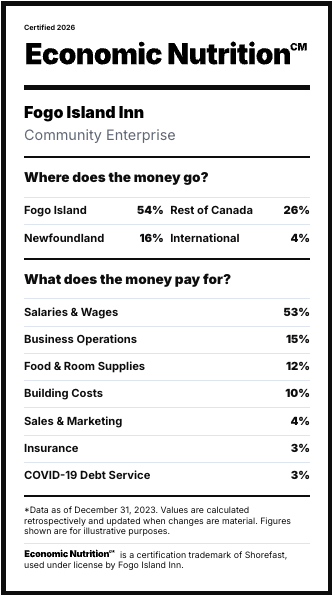
Economic Nutrition uses standardized templates and steps to assign 100% of a business’s spending for a fiscal year into local, regional, national, and international geographies. It also maps all transactions into a business’s major spend categories, like labour and materials.
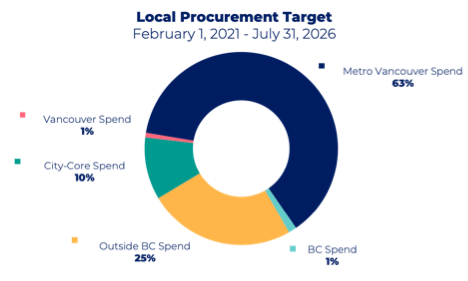
Under the City of Vancouver’s Community Benefits Agreement (CBA) Policy, local is verified using vendor postal codes provided on invoices. On each project where a CBA is applied, the Independent Third Party Monitor random spot checks postal codes against business names, and the City of Vancouver reserves the right to request invoices as evidence of reported local spend.
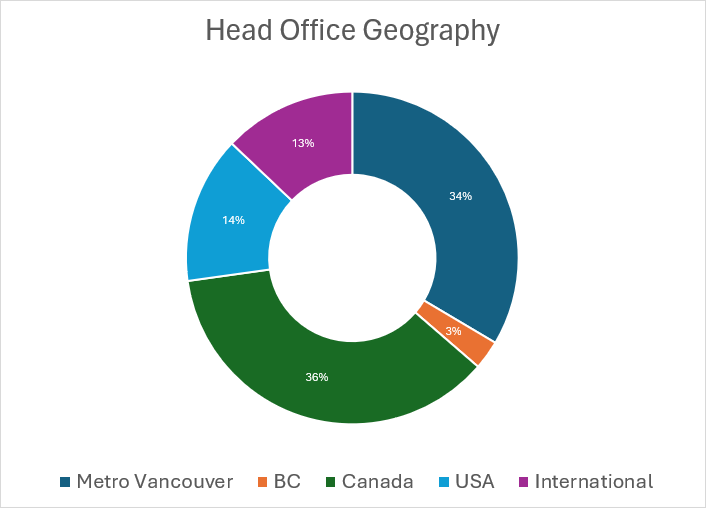
Destination Vancouver aligns their measurement with their more nuanced definition. Their vendor registration form requires vendors to provide their address, head office location, number of employees, incorporation type, ownership diversity, and any social or environmental certifications they hold. This information feeds directly into their finance system, allowing them to pull reports against different local spend requirements as needed. For Q1 of 2026, this approach showed 34% of procurement came from businesses with a head office in Metro Vancouver, 3% from the rest of B.C., 36% from the rest of Canada, and 27% from the U.S. and internationally.
The Government of Saskatchewan learned why it is important to be transparent with what you are measuring. The provincial government was called into question after announcing in spring 2025 that nearly 90 per cent of all procurements over the previous five years had gone to Saskatchewan companies. The opposition party countered that claim, sharing a freedom of information request that showed just 51 per cent of those contracts went to companies actually headquartered in Saskatchewan. “You can’t call a company ‘Saskatchewan-based’ just because they have a local mailing address,” Aleana Young, Opposition critic for jobs and the economy, said in a news release at the time.[2]
Call to action
What gets measured gets managed, so don’t be afraid to act. Use this information to act in the way that fits your organization’s capacity and reflects the goals you are trying to achieve for your community.
To learn more about buy local initiatives within the context of public procurement, check out Buy Social Canada’s Local Briefing Note and Trade Agreements Primer.
Tailor the definition of local to your organization and community goals and context but make sure the definition is also something that can be measured and reported on. Be transparent, celebrate what local spend has been achieved, and use your data to inspire further action.
Here is what you can do next:
- Take advantage of the high-value Engage Member Package or evidence leadership in your sector like Destination Vancouver as a Buy Social Leader to advance research and internal implementation and reporting.
- Make your dollars go further to support community when you purchase from Buy Social Canada Certified Social Enterprises, and other local non-profits, co-operatives, Indigenous and diverse-owned businesses.
- Reach out to us if you would like customized support or have any questions.
[1] https://www.locobc.ca/locobc-research
[2] https://paherald.sk.ca/sask-government-says-its-doing-more-business-with-local-companies/
